
Do we Spaniards believe that our house is a healthy home?
Of the more than 25 million homes in Spain, it is estimated that nearly 80% are inefficient, which translates to over 20 million homes whose materials or construction quality are potentially harmful to the health of their inhabitants. Furthermore, more than half of the existing building stock is over 40 years old.
To mark World Health Day, which is celebrated this Friday, April 7, we have conducted an analysis of homeowners' perceptions of the influence of housing on the health of its inhabitants, a study that is part of our First Observatory on Housing and Sustainability .
Thus, this analysis reveals that, despite the age and inefficiency of Spanish homes, 71.9% of owners claim to live in a healthy home.
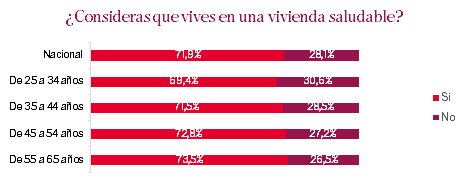
By age, homeowners aged between 55 and 65 (73.5%) are the ones who most consider their home to be efficient, while this perception drops to 69.4% in the case of young people aged 25 to 34.
By gender, men (74.4%), to a greater extent than women (69.5%), are those who believe they live in a healthy home.
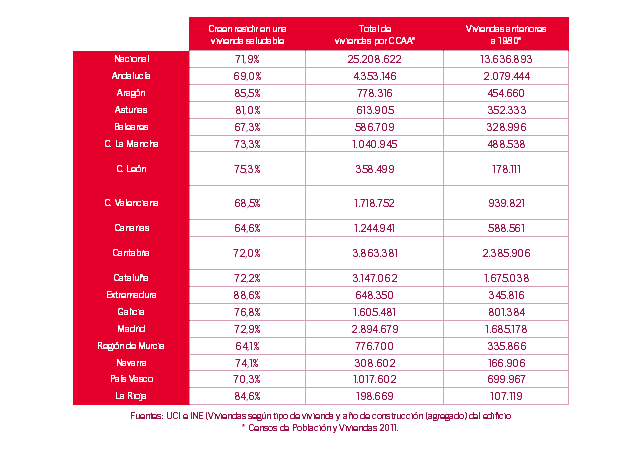
Analyzing this perception across the rest of the country and comparing it with the actual building stock in each of the autonomous communities reveals that homeowners in Extremadura (88.6%), Aragon (85.5%), and La Rioja (84.6%) are the most likely to believe they live in healthier homes. At the other end of the spectrum are the Region of Murcia (64.1%), the Canary Islands (64.6%), and the Balearic Islands (67.3%).
 Healthy housing: factors that most influence the health of its inhabitants
Despite the perception held by most homeowners, not all Spaniards enjoy a healthy home. Dampness, lack of natural light, poor heating and cooling, inefficient sound insulation, poor indoor air quality, and limited accessibility are some of the housing issues that Spanish homeowners most frequently cite as detrimental to their health. All these harmful elements have something in common: they are often found in residential buildings constructed before the 1980s.
In fact, the WHO (World Health Organization) defines healthy homes as “residential spaces that promote the health of their occupants, a refuge that sustains a state of physical, mental, and social well-being.” This definition could be expanded to include homes that are well-constructed, with materials and features that positively impact the health of their residents, such as good lighting, outdoor spaces, and nearby green areas.
For its part, the Spanish Society of Cardiology (SEC) points out that environmental pollution is one of the emerging cardiovascular risk factors, a factor that has positioned itself fourth on the list of aggravating or triggering factors for cardiovascular diseases, only behind hypertension, smoking and poor diet.
In this sense, at UCI we also wanted to know what, according to homeowners, are the factors present in their homes that could most affect their health.
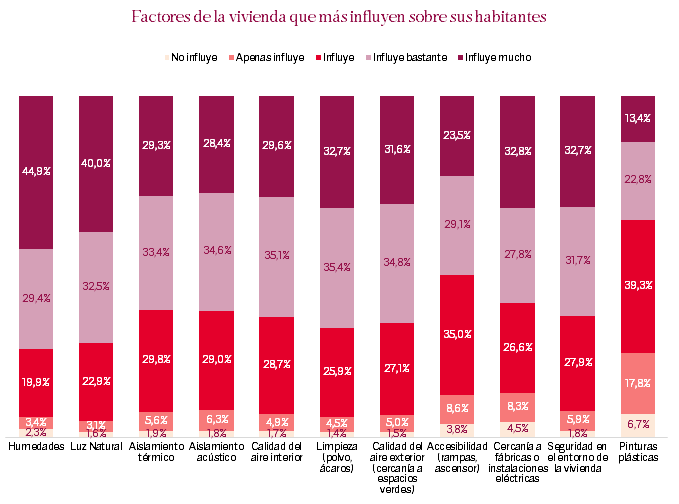
Thus, those surveyed consider it important for health to have natural light (95.31%), followed by not having humidity (94.22%), cleanliness (94.02%), the quality of the outdoor air (93.52%) and indoor air (93.37%) or the safety in the environment of the home (92.27%).
Following behind are aspects such as housing accessibility (87.5%) or proximity to factories or electrical installations (87.19%), with plastic paints being the least relevant for 75.47%.
According to Catia Alvés, Director of Sustainability and Rehabilitation at UCI: “Just as with the energy efficiency of buildings, it is necessary to raise awareness so that citizens become increasingly conscious of the factors in our homes that affect our health and well-being on a daily basis. Only in this way can we transform our homes into optimal spaces for our physical and mental health.”
Problems associated with and solutions to these home conditions
Urban health is understood as the overall health (mental, social, and physical) of people living in urban environments. In this sense, we have also analyzed how each of these factors surrounding a home influences and affects health:
- Humidity: The ideal humidity level should be around 40%–60%. A dry environment, below 40%, will cause dryness in the mucous membranes and orifices of the eyes, nose, and throat; while excessive humidity leads to the proliferation of mold and dust mites, which can cause respiratory problems and allergies. Humidity is closely related to thermal insulation, but proper ventilation is also important to counteract it.
2. Light: A home with good sunlight helps reduce eye strain and irritability, as well as contributing to the regulation of metabolic systems.
3. Thermal insulation: The home should be kept at a temperature between 20° and 21°C in winter and 25° and 26°C in summer, for which good thermal insulation is essential. For example, living in cold temperatures affects blood pressure and raises heart rate, while excessive heat increases dehydration, infections, and respiratory and skin problems, such as dry skin.
4. Sound insulation: Noise pollution in a home can affect physical and mental health, causing hearing problems, stress, and alterations in the cardiovascular, endocrine, and digestive systems. Having good exterior insulation is, once again, the best solution for protecting against noise.
5. Indoor Air Quality and Cleanliness: Pollen, dust, mites, odors, smoke, and other pollutants are just some of the substances that permeate the indoor air of any home daily. Given the significant amount of time spent indoors, it is vital to maintain good indoor air quality through filtration and purification systems to remove particles and potential contaminants. Controlled mechanical ventilation systems also help to renew the indoor air. Furthermore, having plants in the home contributes to air purification.
6. Outdoor Air Quality: Air pollution causes more than 10,000 deaths annually in Spain and approximately 7 million worldwide, according to data from medical and scientific societies and the WHO. These figures are the result of respiratory and cardiovascular diseases. Furthermore, environmental pollution also causes illnesses, ailments, and discomfort that can lead to chronic and even fatal diseases. In this regard, we can choose to live in areas away from traffic, promote the use of clean energy, and opt for mobility alternatives with a smaller ecological footprint, as well as address the re-naturalization of cities through public-private partnerships.
7. Accessibility: Since December 2017, the General Law on the Rights of Persons with Disabilities and their Social Inclusion has required homeowners' associations to guarantee the use of common areas of the building for people with disabilities who need them. However, only 0.6% of residential buildings in Spain are universally accessible. Furthermore, 63% of buildings are not accessible from the street to the entrance, and 22% lack an elevator, a situation that has forced 22% of people with reduced mobility to move, according to the Mutua de Propietarios Foundation. This situation particularly affects older people and those with reduced mobility, although subsidies and grants are currently available for homeowners' associations to carry out renovations aimed at improving accessibility.
8. Proximity to industrial areas: The proximity of homes to industrial facilities that release toxic substances into the environment could be a potential source of exposure to known and suspected carcinogens, as well as endocrine disruptors that have been linked to an increased risk of breast cancer, according to a CIBERESP report. Furthermore, another study conducted in 2020 by the Carlos III Health Institute linked proximity to industrial facilities that release toxic substances into the environment with an increased risk of colorectal cancer.
In this sense, the 3-30-300 rule , developed by urban forestry engineer Cecil Koninjnendijk , suggests that everyone should see at least three trees from their home, that there should be 30% vegetation cover in every neighborhood, and that no one should live less than 300 meters from a park.
9. Safety in the environment: Although the Global Peace Index ranks our country 29th out of 163 nations analyzed, safety is often considered a very important factor when choosing a home. A feeling of insecurity can have repercussions in terms of stress and anxiety, impacting health.
10. Plastic Paints: Interior paints in our homes have a significant impact on health because they can contain heavy metals, formaldehyde, and volatile organic compounds (VOCs) , pollutants harmful to humans, as well as petroleum derivatives. While toxic substances like lead and cadmium have been reduced in recent years, it is advisable to decorate our walls with eco-friendly paints made from plant-based ingredients such as sunflower oil or beeswax. This will be healthier for the people living in the home and also for the planet.
According to Javier Torremocha, Commercial Director of Rehabilitation in ICUs: “Thanks to the Next Generation EU Funds , we are in an ideal position to invest in renovation projects that improve energy efficiency and home comfort, thus helping to prevent health problems caused by poor housing conditions. Investing in improved insulation and thermal comfort should be the first step, although it always depends on each individual case.”
Now that you know the perception of Spaniards and how our homes and their location influence our health and well-being, do you think yours is also a healthy home?


