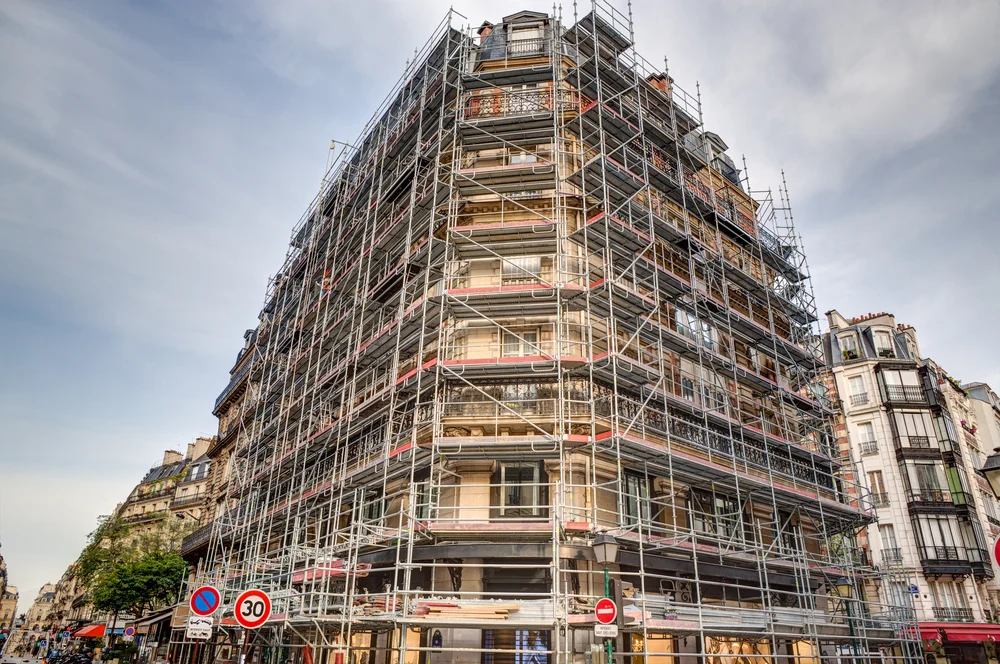
The rehabilitation of homes and the overall housing stock is a major challenge facing households, although a lack of awareness among homeowners often hinders these types of projects. The good news is that a shift in trend is beginning to emerge, and Spanish homeowners are now demanding more sustainable housing.
In fact, 85% would invest in improving their home's energy efficiency. Furthermore, more than half (50.2%) would propose renovations at their homeowners' association meeting, according to a recent perception survey we conducted at UCI . However, despite this growing interest, there is still a significant lack of awareness regarding the mechanisms for these improvements, which hinders the implementation of such projects. In this post, we'll help you clear up some of the most frequently asked questions about home and community renovations.
1. Home renovation vs. rehabilitation. Are they the same?
Although both concepts may seem the same, it is not the same to talk about a home renovation as it is to talk about a rehabilitation , since the development of the work, its needs and characteristics will define the differences between these two housing actions.
To give you an idea, when we talk about renovations, we generally mean modifications that involve changes to finishes, materials, or other components, and that are related to the aesthetics of the home. For example, we've just bought a house and decide to change the doors or retile the bathrooms.
2. What is considered housing rehabilitation?
Unlike a renovation, and according to the definition provided by the Technical Building Code (CTE), the rehabilitation of a dwelling includes those modifications that aim to achieve one of these three objectives:
- Structural adaptation: works that provide the building with conditions of structural safety, stability and mechanical resistance.
- Functional adaptation: rehabilitation works that provide the building with better conditions regarding basic requirements, removal of barriers, improvement of accessibility , etc.
- Building remodeling: which aims to modify the area intended for housing or to modify the number of available housing units.
A project is considered to be a comprehensive rehabilitation project when its objective is to achieve the three objectives mentioned above.
In addition, the CTE incorporates a basic energy saving document which establishes the basic requirements in energy efficiency and renewable energies that new buildings and those that are renovated or rehabilitated must meet.
- Limitation of energy demand (heating and cooling).
- Performance of thermal installations.
- Energy efficiency of lighting installations.
- Minimum solar contribution for domestic hot water.
- Minimum photovoltaic contribution of electrical energy.
3. Are there subsidies available for rehabilitation work?
Yes, the arrival of Next Generation EU funds, channeled through the aid program for the comprehensive rehabilitation of residential buildings and homes developed by the Ministry of Transport, Mobility and Urban Agenda (MITMA), represents a direct boost to the energy-efficient renovation of buildings in our country, with a budget of over €6.8 billion, of which €3.4 billion is directly allocated to housing rehabilitation. These subsidies are distributed through the autonomous communities and cities of our country.
In general terms, this aid will entail the Savings of between 40% and 80% on rehabilitation costs . In addition to these grants, there are currently subsidies from other organizations that are compatible with them, such as the Rehabilita Madrid Plan.
4. What actions are considered eligible for subsidies?
According to the Institute for Energy Diversification and Saving ( IDAE ) , attached to the MITMA, the eligible actions correspond to three types:
- Improvement of the thermal envelope (for example with the installation of an EIFS)
- Improving the energy efficiency of thermal installations such as:
- Replacing conventional energy with solar thermal, geothermal or biomass energy in thermal installations
- Improved energy efficiency of generation subsystems not previously included, such as the heat pump.
- Improvement of the energy efficiency of distribution, regulation, control and emission subsystems of thermal installations.
- Improvement of lighting facilities
The following actions will not be eligible for subsidies: those carried out in newly constructed buildings, those that involve an extension increasing the surface area or volume of a building, and those that entail a change of use. Furthermore, actions related to heating systems or thermal generators that use fossil fuels will also not be eligible for subsidies.
5. Who can benefit?
Funding for rehabilitation and efficiency improvements in homes depends on the type of building or who the beneficiaries are.
Thus, according to the beneficiaries, these can be divided into three groups:
- Single-family homes or apartments.
- Community of neighbors.
- Neighborhood or residential area.
In addition, the following entities may apply for subsidies for homeowners' associations:
- Homeowners Associations
- Owners or usufructuaries, whether natural or legal persons.
- Public companies, commercial companies, organizations, or entities that own residential properties.
- Building owners.
- Cooperatives of home or building owners and those that are under a system of transfer of use of their homes.
- Companies and cooperatives that lease or hold concessions for buildings.
- Tenants of housing who document that there is an agreement with the owner to pay for the works.
6. How can I apply for European aid for housing rehabilitation?
Since this summer, most of the Autonomous Communities have opened their aid programs for owners and communities of neighbors, so you can apply for them by going to any administration office of the autonomous community in which you reside.
Furthermore, the Housing and Land Department of the Ministry of Transport, Mobility and Urban Agenda recommends contacting a Rehabilitation Agent by consulting professional associations such as the COAM (College of Architects of Madrid) , sector associations or the Rehabilitation Offices that are being set up in the Autonomous Communities.
7. Will I have any tax advantages?
Yes. Royal Decree-Law 19/2021 stipulates tax deductions of 20%, 40%, and 60% for energy efficiency improvements in homes carried out from October 2021 onwards. These deductions are among the measures proposed by the Government to promote the energy rehabilitation of buildings and private homes through the Recovery, Transformation, and Resilience Plan, funded by the European Next Generation funds.
8. How do I know if my home needs an energy renovation?
The average age of buildings in Spain is over forty years , with 42% (10.4 million) built between 1950 and 1980 and almost 30% (6.5 million) before 2000, according to data from the National Statistics Institute (INE) and the Ministry of Public Works. Furthermore, four out of five Spanish buildings are inefficient, consuming more energy than necessary due to poor insulation and energy performance.
To find out if your home needs renovation, you should check its construction year and Energy Performance Certificate (EPC) , a document that has been mandatory since 2013 for all properties to be sold or rented and which analyzes CO2 emissions and energy consumption. The EPC information is valid for ten years and is expressed on a letter scale from A (most efficient homes) to G (least efficient).
9. Is the installation of an elevator in a residential building considered a renovation project?
Yes. As we saw at the beginning, installing an elevator represents a functional upgrade of the building. Furthermore, this improvement enhances the building's features, making it accessible to people with reduced mobility and improving the comfort of all residents. This increases the building's and its apartments' market value, making them more attractive to tenants and potential buyers.
10. What is a SATE?
The ETICS, or External Thermal Insulation Composite System, refers to the system used to insulate a building both thermally and acoustically. It's like putting a coat on the building, as it involves applying an insulating material to the exterior wall. This insulates the facade, improving thermal comfort in homes and reducing energy loss, which translates into greater energy efficiency and savings on energy costs.


