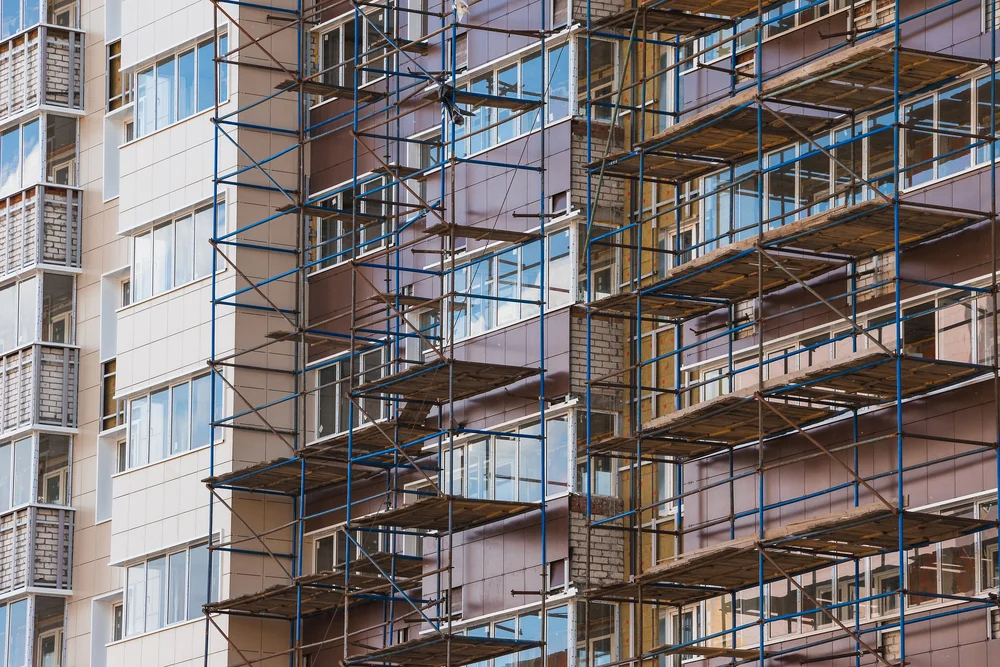
According to data from the National Association of Distributors of Ceramics and Construction Materials (Andimac), approximately 1.75 million homes were renovated in Spain in 2022, which translates to 1.4% less than in 2021.
In this context, 2023 is presented as the scenario for the maximum deployment of the Next Generation EU Funds, which places this year as a key year for the development of housing rehabilitation in Spain.
Therefore, at UCI we have analyzed the main challenges that the sector will have to face in order to definitively boost energy rehabilitation in Spain:
1. Large volume of housing that requires rehabilitation and conditioning.
One of the main challenges when implementing energy-efficient renovations in Spain is the large number of homes that require this type of upgrade. The latest data from the National Institute of Statistics (INE) confirms that there are more than 18 million primary and secondary residences in Spain , 66% of which were built before 1990 .
These figures imply that more than two-thirds of Spain's housing stock needs rehabilitation and conditioning to meet the zero emissions targets set for 2050, as they do not meet current conditions and standards of habitability, thermal insulation and energy saving.
2. Growing need to increase annual rehabilitations
In Spain, an average of 30,000 energy-efficient home renovations are carried out each year, a figure that falls short given the speed needed to meet zero-emission targets. In fact, to achieve the zero-emission goals agreed with the European Union by 2050, this number would need to increase by 900% to 300,000 renovations annually.
3. Growth in material prices
2022 ended with an inflation rate of 5.7%, 3.7 percentage points lower than the OECD average. Although the inflationary spiral that erupted with the war in Ukraine has gradually subsided, some sectors in Spain continue to be affected by rising prices, one of which is the construction materials sector used in renovations and refurbishments.
So much so that Andimac warned that the market price of these raw materials grew by around 9% during 2022. However , this year, the trade association expects a moderation in material prices in line with projected inflation, registering a growth of 1.2% in the residential materials market.
4. Lack of skilled labor
The construction sector is currently experiencing a period of strong employment. The latest data from the Spanish National Statistics Institute (INE) indicates that in the last quarter of 2022, over 1.3 million people in Spain were employed in this sector, representing an increase of almost 15,000 workers. However, not all construction workers are qualified to specialize in energy-efficient building renovations, as specific knowledge of energy efficiency and insulation, among other areas, is required to properly carry out a home renovation.
In fact, one of the main challenges in this regard is the lack of available labor to undertake these projects . The need for personnel in home renovations is estimated at 700,000 workers, according to Andimac . This shortage is also contributing to longer project delivery times and a salary increase for professionals, which is projected to rise between 2.5% and 3% in 2022.
5. Lack of information among citizens
The vast majority of Spaniards are aware of the importance of having a healthy and energy-efficient home. Proof of this is that 85% of homeowners in Spain would invest in improving their home's energy efficiency, and 50.2% would propose a renovation at their homeowners' association meeting, according to our latest report.
Motivation is not lacking among Spaniards, but they lack the necessary information to implement these improvements. This same survey reveals that 84% of homeowners consulted are unaware that part of the Next Generation EU funds will be allocated to home renovations , while 77% are also unaware of the existence of specific funding for homeowners' associations.
6. Use of home automation to help with energy efficiency
Another of our studies reveals that 48% of Spaniards have home automation systems to increase energy efficiency and comfort in their homes, and by 2024 it is estimated that 20% of homes will have at least one connected device to meet these objectives.
“The challenge, in this sense, is to promote the advantages that new technologies have to generate long-term economic and energy savings,” argues our Director of Sustainability and Rehabilitation, Catia Alvés , who also predicts that “smart light bulbs and meters will be the most in-demand devices to optimize energy consumption in Spanish homes in the short and medium term.”
7. Encourage the self-consumption market
Spain enjoys approximately 500 hours of sunshine per year , making it one of the sunniest countries in Europe, along with Italy, Greece, and Portugal. This makes Spain a prime location for producing clean and efficient energy through solar power and photovoltaic panels, capable of generating savings of €3,000 over ten years.
“Renovation is the tool that Europe and Spaniards have to achieve a decarbonized continent, where all citizens will benefit, and it is clear that the European Commission has a clear strategy geared towards this,” says Cátia Alves, who also affirms that the main obstacle to overcome will be “raising awareness among the entire population about the advantages of having an efficient home.”


