Madrid, September 24, 2026 – The international buyer of property in Spain is undergoing a profound transformation. Far from the traditional image associated with second homes for vacations, foreign demand is evolving towards more diverse profiles, with greater purchasing power and a growing interest in establishing residency in the country, according to the report International Buyers - Real Estate Market 2025 & 2026 Outlook , prepared by UCI, Unión de Créditos Inmobiliarios, a specialist in sustainable housing finance.
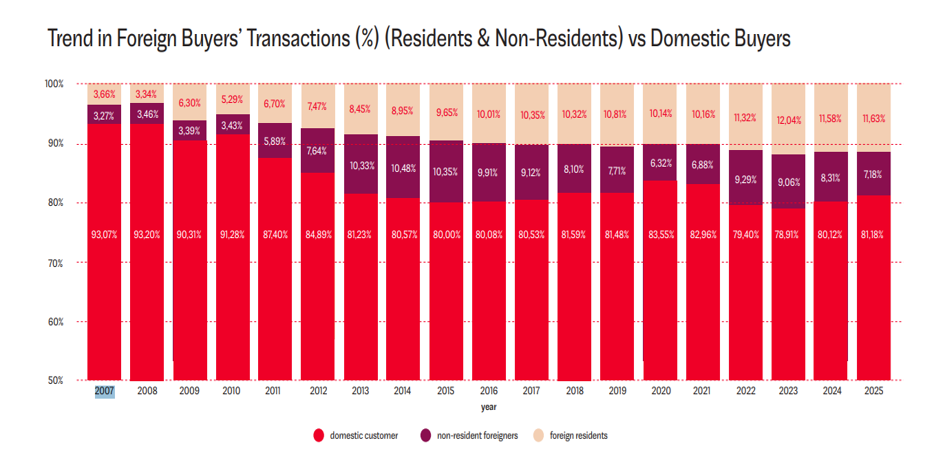
One of the most significant changes is the growing role of foreign buyers already residing in Spain. In 2025, this group represented 11.6% of the residential market, compared to 7.2% for non-resident buyers, consolidating a trend that reflects an increasingly stable connection to the country and a demand less tied to the acquisition of second homes.
“For years, the market has associated international buyers with a predominantly vacation or investment profile. However, the data shows a much more diverse and mature reality, in which purchases linked to life projects, professional mobility, or permanent settlement in Spain are gaining ground,” says Lorena A. Zenklussen, Director of Mortgage Financing at UCI .
A buyer with greater purchasing power
The study also highlights the difference between the purchasing behavior of domestic and international demand. In 2025, foreign buyers paid an average of €2,479 per square meter compared to €1,839 per square meter paid by domestic buyers, representing a difference of nearly 35% .
Furthermore, the average amount spent by foreigners on home purchases reached 204,365 euros, 40% more than in 2019 , reflecting a clear trend towards higher value assets, concentrating in the middle and upper segments of the residential market.
This reality is especially visible in areas with high international demand, where the purchasing power of these buyers exerts a significant influence on market dynamics and price evolution.
Nationality matters more and more.
Another key finding of the report is that it is no longer possible to speak of a single profile of international buyer. The market has diversified considerably in recent years. In addition to the main nationalities of non-resident buyers—the United Kingdom, Germany, and Morocco— the Netherlands, the United States, Belgium, Sweden, and Poland are gaining prominence and contributing to a much more heterogeneous international demand than in previous decades.
Furthermore, purchasing behavior differs significantly depending on nationality. There are substantial differences in the type of property purchased, the amount spent, the financing options used, and the locations chosen. According to the report, nationalities such as Swedish, American, German, and Swiss are among those paying the highest average prices per square meter.
From the international buyer to the international ecosystem
Foreign demand is also transforming the way the real estate and financial sectors relate to this group.
According to UCI, the data indicates that the international market can no longer be treated as a homogeneous segment. Different nationalities exhibit distinct residency patterns, financing needs, purchasing power, and territorial preferences, necessitating a shift towards increasingly specialized advisory and support models.
This evolution coincides with a progressive geographical diversification of demand. Although the Valencian Community, the Balearic Islands, the Canary Islands, and Andalusia continue to concentrate a large part of international transactions, the report identifies a growing interest in new residential destinations, including some areas of northern Spain, driven by factors such as quality of life, connectivity, remote work, and the search for less stressful environments.
A more stable and structural international market
The main conclusion of the study is that international demand is consolidating as a structural component of the Spanish residential market, but with very different characteristics from those that explained its growth a decade ago.
In contrast to a vision focused exclusively on investment or second homes, an international buyer is emerging who is more linked to actual residence, with above-average economic capacity and coming from an increasingly wide range of countries .
According to UCI, this evolution will continue to shape how both real estate activity and financing solutions develop in the coming years.


