Madrid, August 10, 2026 – In a context marked by difficulties accessing housing, a shortage of supply in certain areas, and the search for homes that better meet the needs of their owners, self-build housing is beginning to gain traction as a residential alternative among Spaniards. According to the 4th UCI (Unión de Créditos Inmobiliarios) Observatory on Housing and Sustainability , 42% have considered building their own home at some point . This option is particularly attractive to younger buyers and those living in towns and rural areas.
However, there is still a considerable gap between imagining owning a home and actually starting the project. Of all those surveyed, 33% acknowledge having considered self-building as a possibility, while only 8.5% say they have seriously considered it. Furthermore, 12.8% are unaware that this housing alternative exists.
The data thus paints a picture of an option that is still a minority in terms of actual intention, but with significant potential in a market where buyers are exploring new ways to access housing and gain decision-making power over its design, cost, or energy efficiency.
Those under 35 are the most willing to build their own house
Interest in self-building is clearly increasing among younger generations. More than half of those aged 25 to 34 ( 52% ) have considered this option, compared to 46% of those aged 35 to 44 and 42% of those aged 45 to 54. From age 55 onwards, this predisposition drops to 29% .
This evolution by age reflects the search, especially among younger profiles, for formulas that allow them to adapt their home to their real needs, incorporate more functional spaces and have a greater degree of control over the design and features of their future home.
In rural Spain, almost one in two people are considering self-building.
Place of residence also influences interest in self-building. 48% of those currently living in towns or rural areas have considered building their own home, almost eight percentage points higher than among those living in city centers ( 39.9% ) or the suburbs ( 39.6% ). The greater availability of land and the prevalence of single-family homes make these areas particularly conducive to this type of project.
By autonomous community, the Canary Islands leads in interest in self-build housing, with 61% , followed by Extremadura, with 52%. Andalusia, with 47%, and Cantabria, with 46%, are also above the national average. At the other end of the spectrum are Navarre, where the percentage drops to 32%, and the Basque Country, with 24%. 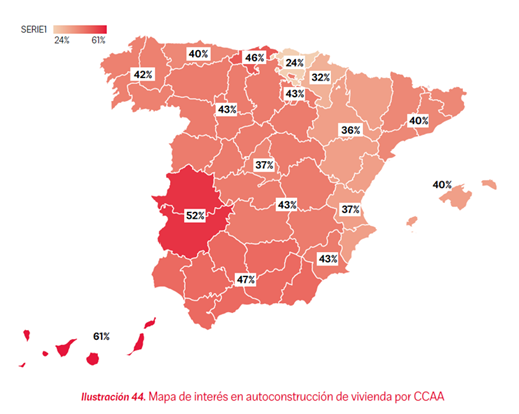
Designing a custom-made home is the main attraction
What leads a buyer to consider building instead of opting for a finished home? Primarily, the possibility of deciding how they want to live.
Almost nine out of ten buyers find some attractive element in self-build and 46% point to being able to design a completely customized home as the main advantage.
25% value the possibility of better tailoring the project to their budget, and 18% highlight the opportunity to build a more efficient and sustainable home from the ground up. Only 11% say they find no appeal in this approach. 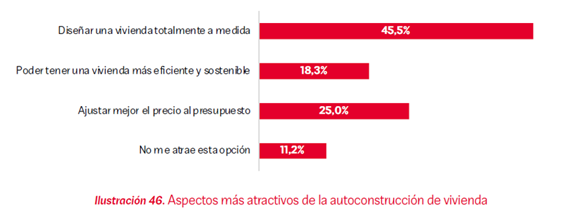
These results show that self-build connects with some of the main demands of today's buyer: greater personalization, a design adapted to different life stages, greater control over the project, and better energy performance.
Two out of three buyers know little or nothing about the process
The main obstacle arises when the idea has to be turned into a real project. Two out of three Spaniards (66%) admit to knowing little or nothing about the self-build process.
38% have heard of this formula but admit to having little knowledge about it, while 28% claim to be unaware of the process. Another 28% only have a general understanding, and nearly 6% say they know the necessary steps to build their own home. 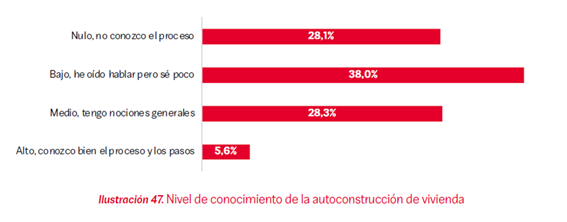
The purchase of the land, the architectural project, the licenses, the execution of the work and financing that accompanies the progress of the construction make the process different from acquiring a finished home.
Lorena Zenklussen, Director of Mortgage Financing at UCI, points out: “Self-build is becoming an increasingly popular option among buyers, especially younger ones and those seeking a home tailored to their needs. However, the limited understanding of the process demonstrates that interest alone is not enough. To transform an idea into a real project, it is essential to offer clear information, expert support, and financing solutions that adapt to the project's gradual progress.”
Traditional construction maintains its leadership
The transformation not only affects who builds the house, but also how it is built.
Brick and concrete remain the most trusted option among Spaniards, chosen by 49% . However, 24% would opt for a modular or prefabricated home, making it the second most popular choice and significantly narrowing the gap with traditional construction methods.
Following behind are wood frame or timber frame construction ( 6% ), steel frame or metal frame construction ( 4% ), and bioconstruction based on natural materials ( 3% ). Furthermore, 14.5% admit they still don't know which system to choose.
The results of the IV Observatory on Housing and Sustainability thus show a buyer who, although still largely trusting in conventional construction, is beginning to open up to new ways of promoting and building their home, especially when these allow for greater personalization, control over the project and efficiency.


