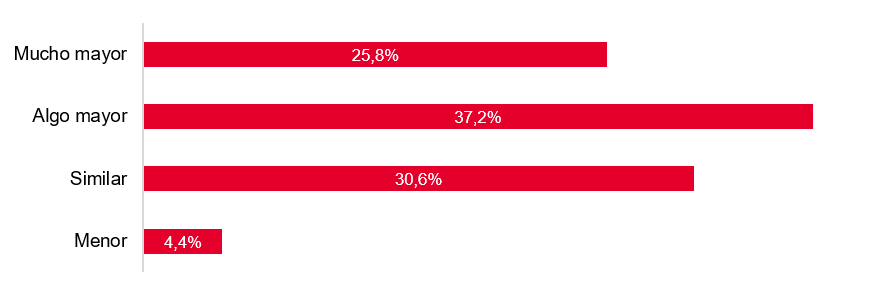
Madrid, September 1, 2026. The start of the school year arrives with households more focused than ever on their finances. In a context marked by rising prices for groceries, energy, and other basic housing-related expenses, household finances are once again at the forefront of family concerns. According to the 4th UCI (Unión de Créditos Inmobiliarios) Observatory on Housing and Sustainability, 63% of Spaniards say their expenses are more or much more burdensome than a year ago.
The report reveals an increasingly visible paradox in households: they are saving more than a year ago, but with less leeway and more sacrifices. Leisure, travel, food, thermal comfort, and home maintenance are among the expenses that citizens have cut back on during the last twelve months to try to sustain their family budget.
“The data reflects that many families are making a constant effort to organize their expenses and maintain some savings capacity, but it also shows that this effort is not always supported by sufficient planning tools. Financial education is key to anticipating payments, prioritizing decisions, and better managing available household resources,” says Lorena A. Zenklussen, Director of Mortgage Financing at UCI.
Expenses weigh more heavily, especially in Castile and León, Aragon, the Balearic Islands and Madrid
The perception of increased household spending is not uniform across the country. Castile and León (71%) leads the ranking of regions where the most households report a significant increase in their expenses over the past twelve months. Aragon, the Balearic Islands, and Madrid follow, all at 69%.
At the opposite end of the spectrum are La Rioja (52%), Catalonia (56%), and Navarre (58%), where this perception is less intense. Even so, the data show that the pressure on household finances is widespread and affects a majority of Spanish households.
Perception of the weight of household expenses in the last twelve months by Autonomous Community
| Autonomous Communities | Much older | A little older | Similar | Minor |
|---|---|---|---|---|
| National | 25.8% | 37.2% | 30.6% | 4.4% |
| Andalusia | 28.1% | 33.5% | 32.2% | 4.8% |
| Aragon | 24.1% | 45.2% | 28.3% | 1.2% |
| Asturias | 24.1% | 40.2% | 32.1% | 3.6% |
| Balearics | 22.7% | 46.6% | 27.0% | 3.7% |
| Castile and León | 22.3% | 48.9% | 23.0% | 2.8% |
| Valencian Community | 24.3% | 36.3% | 28.8% | 6.9% |
| Canary Islands | 23.0% | 37.0% | 31.4% | 4.8% |
| Cantabria | 25.3% | 42.1% | 24.4% | 4.8% |
| Castilla-La Mancha | 22.3% | 39.9% | 32.2% | 3.4% |
| Catalonia | 24.7% | 31.5% | 35.9% | 5.5% |
| Estremadura | 16.2% | 48.3% | 29.6% | 4.9% |
| Galicia | 24.2% | 42.0% | 31.2% | 1.8% |
| Madrid | 33.3% | 35.8% | 25.0% | 4.2% |
| Region of Murcia | 24.5% | 43.5% | 30.7% | 1.2% |
| Navarre | 14.6% | 43.2% | 34.7% | 3.6% |
| the Basque Country | 25.7% | 34.6% | 35.5% | 2.1% |
| Rioja | 15.9% | 36.4% | 36.7% | 8.6% |
Table 1. Perception of the weight of domestic expenses in the last twelve months by Autonomous Community.
One in four Spaniards admits that they do not have household expenses under control.
Managing household finances remains a challenge for a significant portion of families. Although 72% of Spaniards claim to have their monthly household expenses fully or fairly well under control, 26% admit to having little or no control over them, according to UCI. 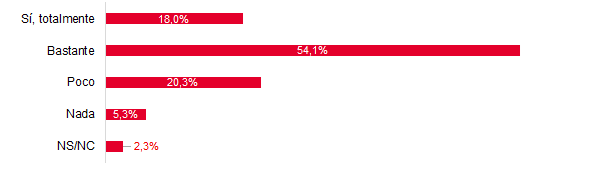
The lack of control is especially significant among those who are unable to save at the end of the month. In this group, 71% say their household expenses are higher than a year ago, and only half claim to have their finances under control.
The age-based analysis also points to a generational gap in household budget management. Younger individuals report greater difficulty in keeping their monthly expenses under control, while the perception of control increases progressively in older age groups. This difference may be linked to life stages characterized by recurring expenses, access to or payment for housing, and reduced financial stability. 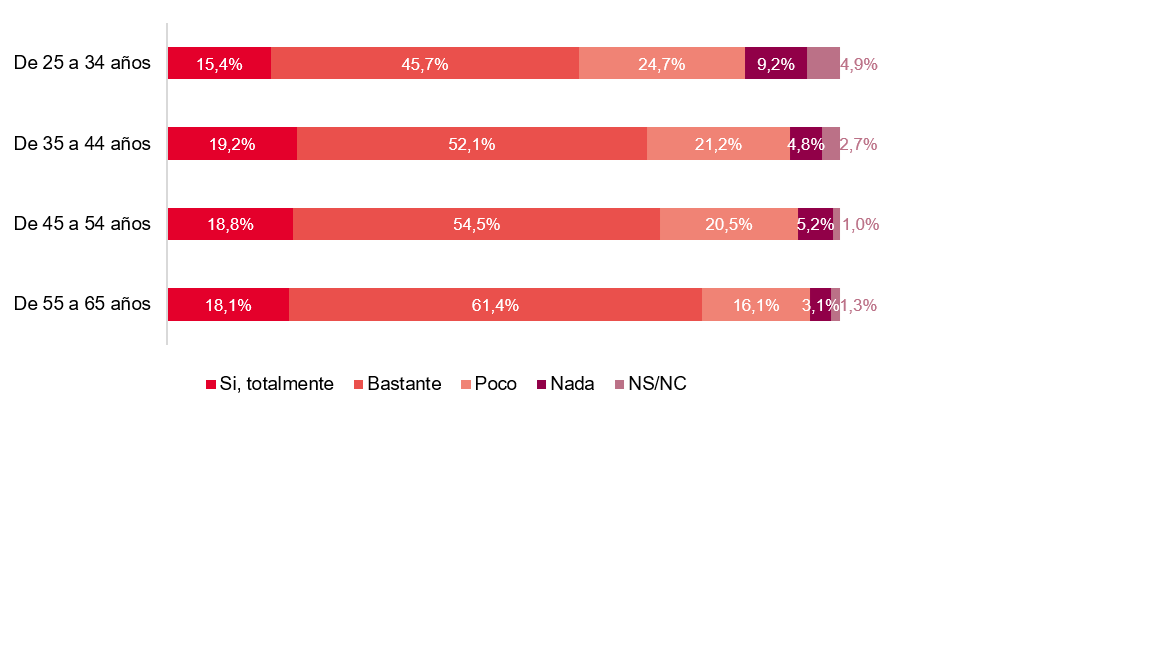
Savings are holding steady in households: an average of 300 euros is being saved per month
Although households are experiencing increased pressure on their domestic expenses, saving remains a part of the financial habits of most Spanish families. According to UCI, 84.2% of citizens report saving regularly.
Furthermore, the declared savings capacity is improving compared to last year: Spaniards claim to reserve an average of 16.2% of their income, compared to 14.6% in 2025, although still below the 17.8% recorded in 2024.
Taking as a reference the average gross salary in Spain published by the INE and transferring it to an approximate net estimate, that percentage would be equivalent to setting aside around 300 euros per month. 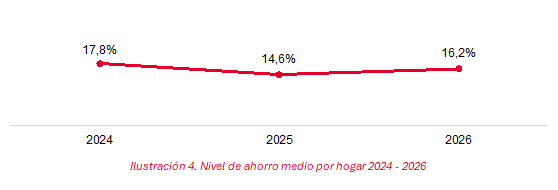
Savings, however, are not distributed equally across regions or generations. By autonomous community, the proportion of people who claim to save exceeds 90% in Cantabria (91.4%), Extremadura (91.3%), Castile and León (90.7%), and La Rioja (90.2%).
At the opposite end of the spectrum are the Canary Islands (78.6%), followed by Aragon (80.6%), Catalonia (81.0%), the Basque Country (81.4%) and Andalusia (81.8%).
There are also significant differences in the percentage of income that households manage to save. While in Castile and León citizens allocate an average of 20.6% of their income to savings, the figure falls to 10.8% in the Canary Islands.
The case of Madrid is particularly significant, as it is one of the regions with the highest income in the country, which shows that the ability to save depends not only on income, but also on the cost of housing, current expenses and the pressure on the family budget. 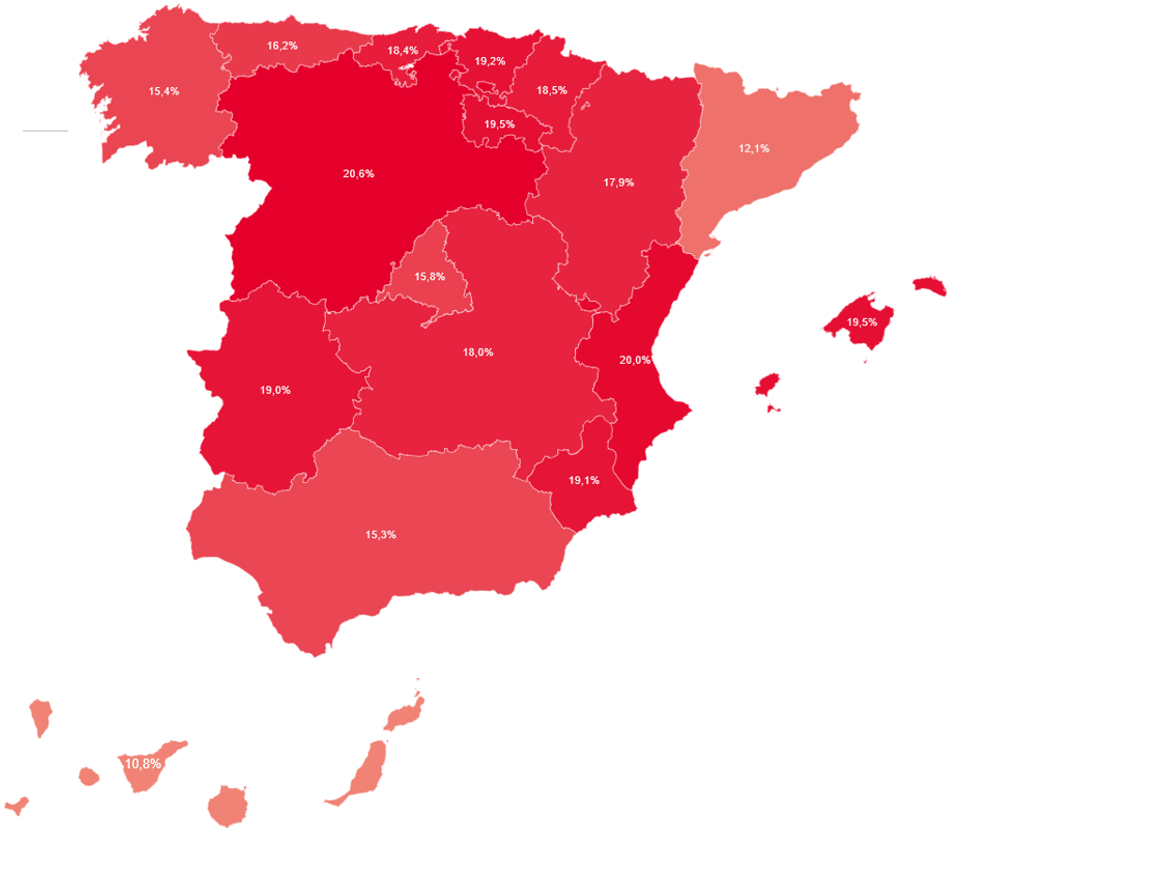
Three out of four Spaniards cite lack of income as the main obstacle to saving
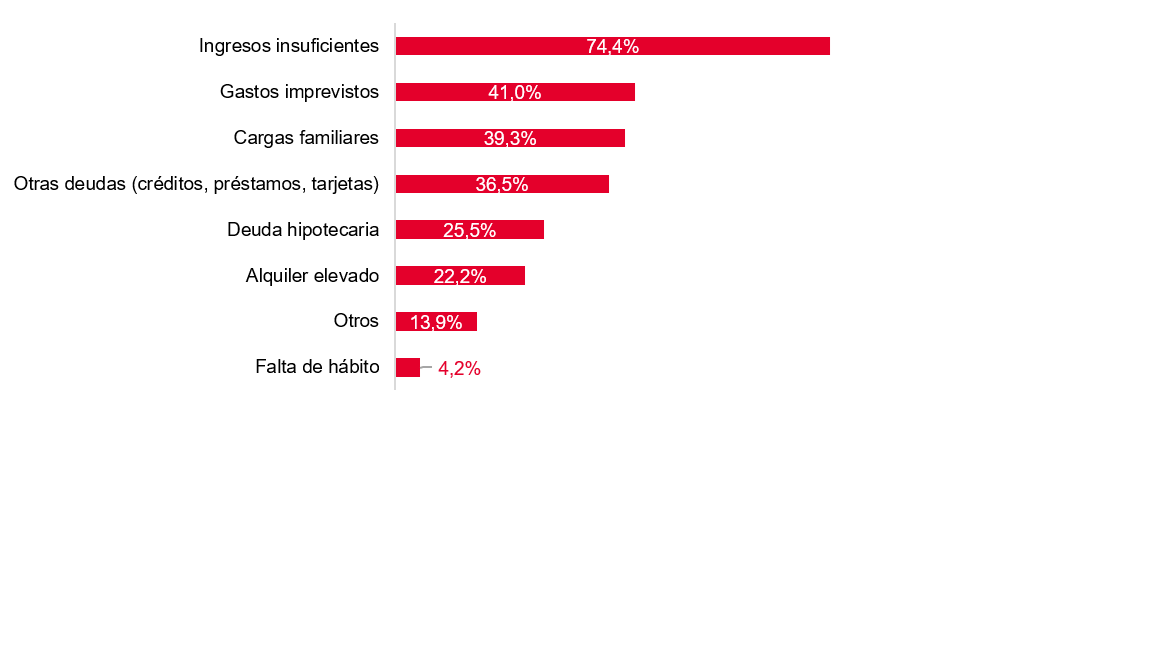
Households' ability to save is primarily determined by their available income. In fact, 74% of citizens identify insufficient income as the main barrier to saving, far ahead of other factors such as unexpected expenses (41.0%), family responsibilities (39.3%), or debt associated with loans and credit (36.5%).
The data shows that difficulties in saving are more a matter of financial capacity than of financial habits. Only 4.2% attribute their lack of savings to a lack of habit, while one in four Spaniards cite mortgage debt (25.5%) and 22.2% cite the high cost of rent, highlighting the significant role that housing-related expenses continue to play in household finances.
More than 7 out of 10 households have reduced or eliminated some expenses in the last year
Improved savings do not necessarily translate into greater financial freedom. In fact, 78.6% of households report having reduced or eliminated some expenses during the last year, a figure that suggests that, for many families, saving still depends more on adjusting consumption than on a real improvement in their economic situation. 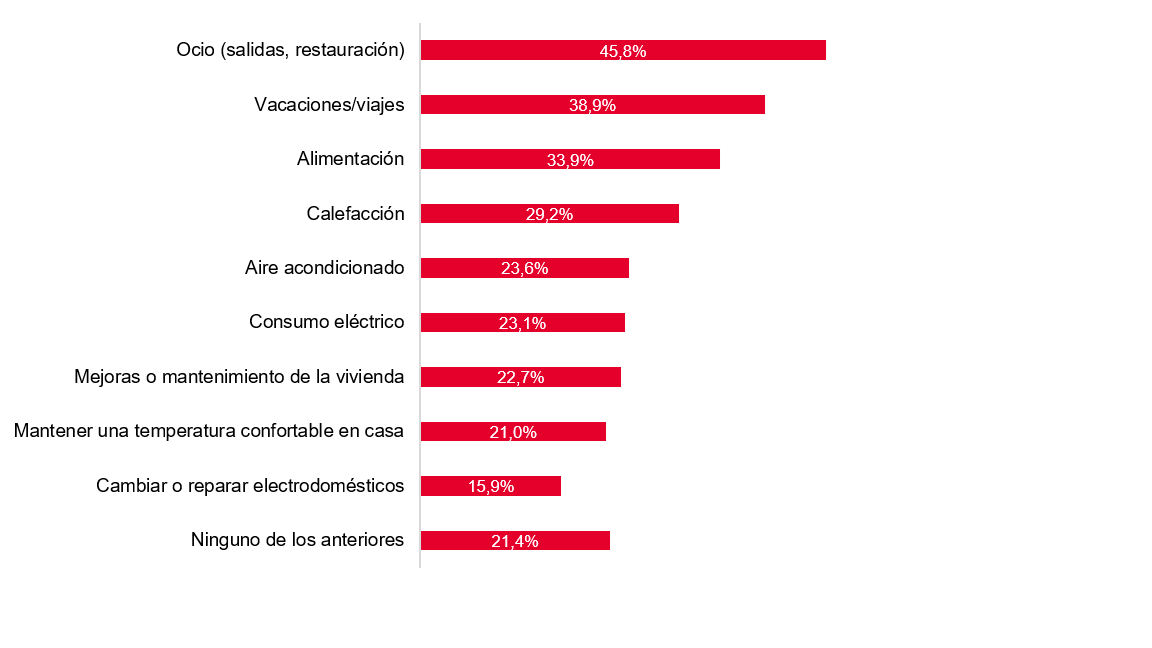
When it comes to adjusting the budget, the first sacrifices are made in leisure activities. 46% say they have reduced going out, dining out, or other activities outside the home, while 39% have cut back on vacations or trips.
The pressure on the family budget also affects more basic items: one in three Spaniards (34%) say they have reduced or given up some food expenses.
These adjustments are also being made at home. 29% report having reduced their use of heating; 24%, air conditioning; and 23%, electricity consumption. Furthermore, 21% admit to having given up maintaining a comfortable temperature at home for economic reasons.
Decisions that directly affect the condition of homes are also being postponed: 23% have postponed improvements or maintenance work and 16% have delayed changing or repairing appliances.
The shopping basket, the main concern
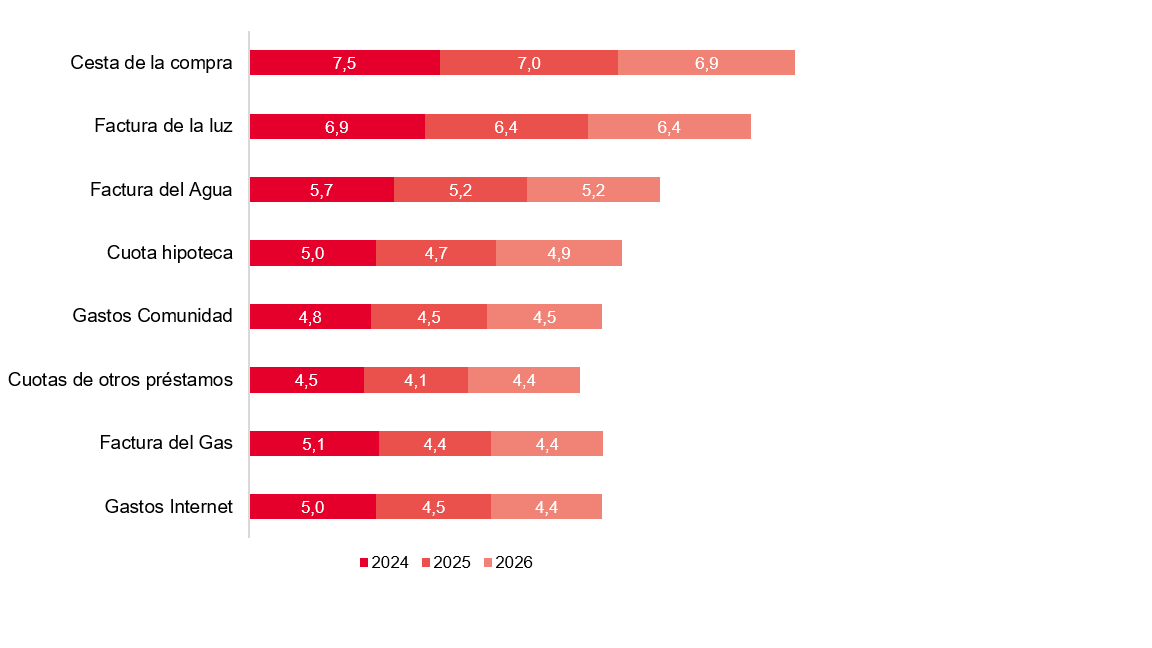
As people return to their routines, filling the refrigerator remains the daily expense that worries Spaniards the most. The grocery basket receives an average concern score of 6.9 out of 10, ahead of the electricity bill, with 6.4 points.
Following behind are the water bill (5.2), the mortgage payment (4.9), community fees (4.5) and the installments of other loans, the gas bill and internet, all with 4.4 points.
29% consider it difficult or very difficult to cope with paying for their home
Housing is one of the largest expenses in many families' household budgets. Almost half of Spaniards consider their mortgage payments manageable, but tight, while 29% describe them as difficult or very difficult. Only 8.6% say they can afford them comfortably. 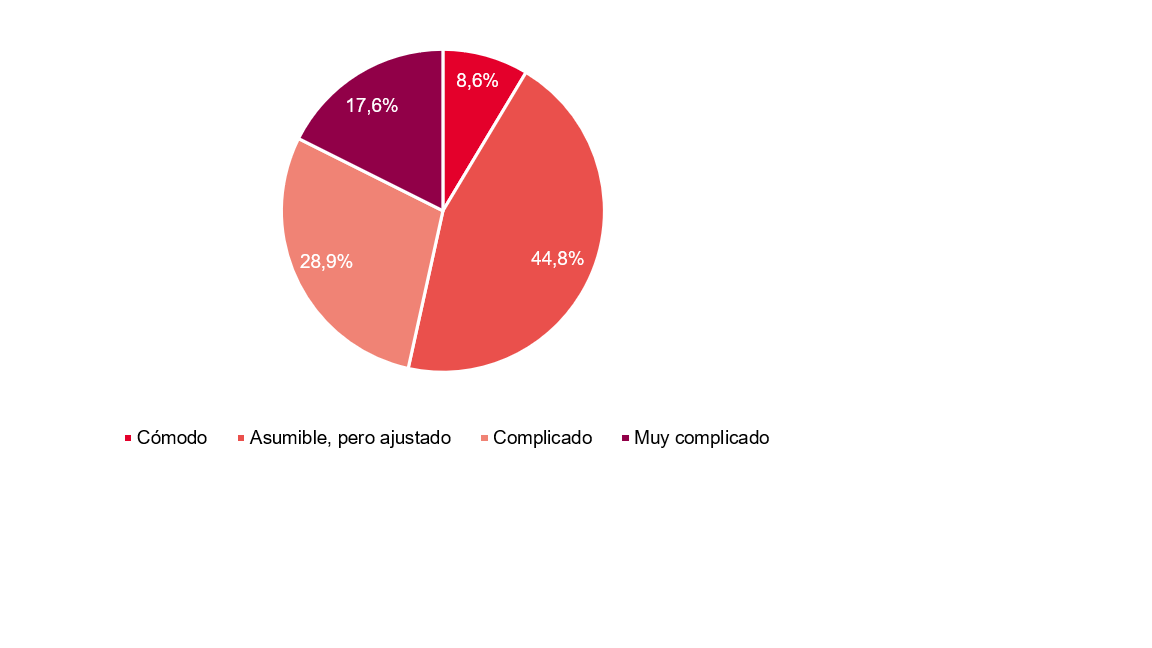
Perceptions change significantly depending on housing situation. 64% of those who already own a home consider the payment comfortable or affordable, compared to 36% of those who do not yet own a home.
The difficulty is also more pronounced among young people. Among those aged 25 to 34, 51% consider it difficult or very difficult to pay for their housing, although they are also the ones who report saving a higher proportion of their income: 22%.
Small gestures to try to contain the bills
In addition to cutting back on certain expenses, households are incorporating savings measures into their routines, especially those that do not require large investments.
- 66% use LED bulbs.
- 56% makes the most of natural light.
- 51% reduces the use of heating or air conditioning.
- 49% control unnecessary water consumption.
- 48% plan their purchases to spend less.
- 39.5% avoid leaving devices on standby.
- 39% control the temperature of the home.
- 31% use energy-efficient appliances during off-peak hours.
These measures show how many households are seeking flexibility in everyday decisions, from energy consumption to shopping plans. In this context, planning expenses, anticipating payments, and reviewing consumption become key tools for facing daily life with greater security and preserving the household's financial stability.


