Madrid, August 26, 2024 – The return from summer vacation and the start of the school year make these weeks one of the times of year with the highest household spending. In this context, 24.5% of Spaniards say they are unable to save at the end of the month, according to a study conducted by UCI, Unión de Créditos Inmobiliarios, a specialist in sustainable housing finance, which analyzes citizens' savings capacity, as well as their concerns and best practices.
Despite household expenses representing a significant portion of Spanish household budgets, 75.5% of respondents report saving part of their monthly income, a figure virtually unchanged from last year's 75.3%. By region, Extremadura (86.4%), Navarre (85.2%), and Cantabria (84%) lead the way with the highest percentage of respondents reporting savings. At the other end of the spectrum are La Rioja (61.5%), the Canary Islands (64.7%), and Madrid (72.8%). 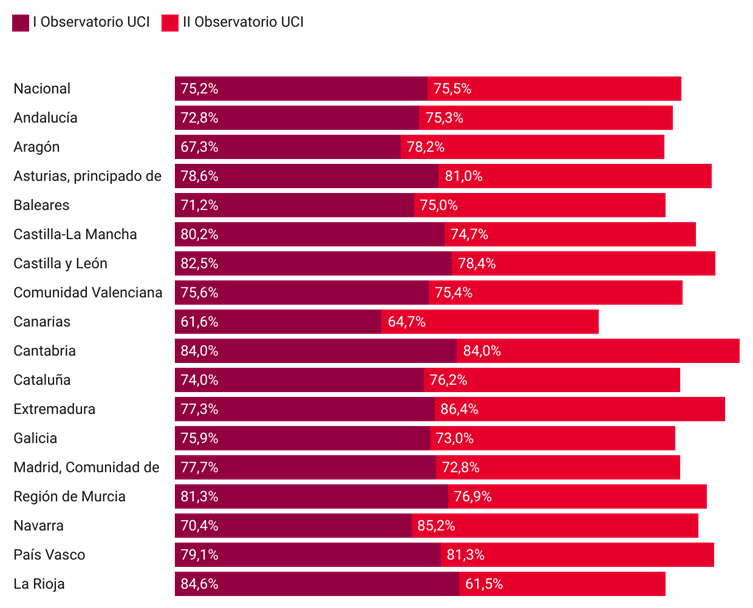
Percentage of Spaniards who report saving at the end of the month by Autonomous Community.
It slightly increases the percentage of income allocated to savings to 17.8%.
Regarding the proportion of income that Spaniards are able to save per month, the figure has improved in the last year to reach 17.8%, 5 percentage points more than in 2023, which represents €342.6 per month, taking as a reference the average salary in Spain, of €1925, according to the latest data from the National Institute of Statistics (INE)*.
By autonomous community, the Basque Country (23.5%), Castile-La Mancha (20.9%), and Aragon (20%) report the highest monthly savings rates. Conversely, residents of the Canary Islands (13.8%), Extremadura (15.4%), and Cantabria (15.7%) are the Spaniards who can allocate the least amount of their income to savings. Furthermore, men tend to save more than women each month, achieving 18.7% and 16.8%, respectively.
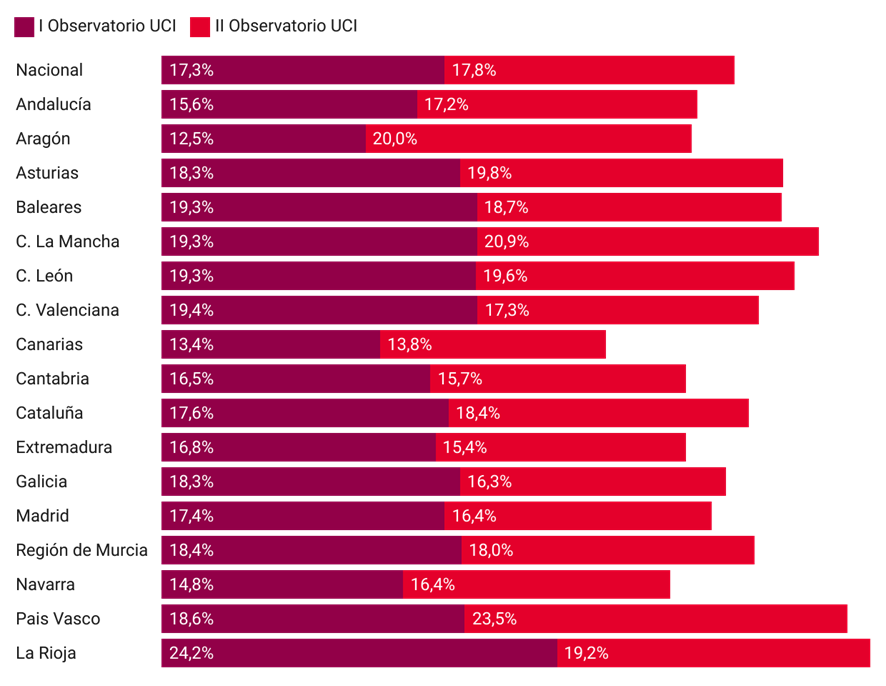
Household savings rate by Autonomous Community.
The cost of groceries and electricity, water, and gas bills are the expenses that worry Spaniards the most.
Although a slight reduction in Spaniards' concerns regarding expenses was identified compared to last year's study - possibly due to lower inflation and lower energy prices - the shopping basket remains at the top of the list (7.47).
Next are the electricity bill at 6.88, the water bill at 5.67, other expenses at 5.28, and the gas bill at 5.14. It should be noted that mortgage payments or community fees are at the bottom of the list of household expense concerns.
However, these concerns vary by age. Those over 55 are more worried about their grocery bill, while those under 55 are more concerned about their mortgage payments and other loans. 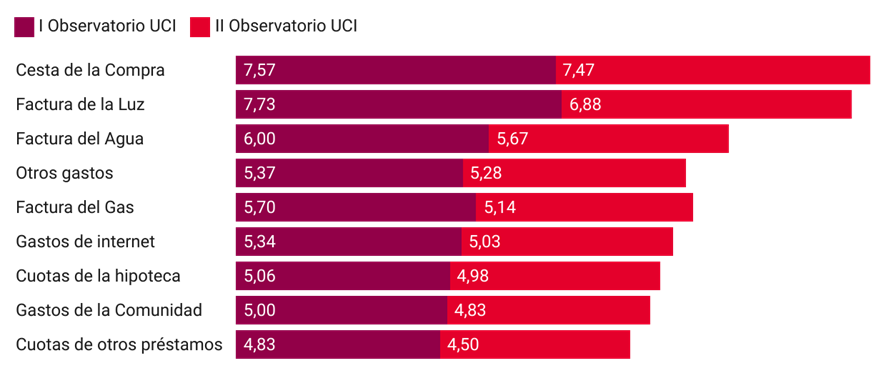
Concern about household expenses on a scale of 0 to 10.
Promoting energy efficiency measures to encourage savings in the home
To save money at home, the majority of Spaniards say they implement measures to improve energy efficiency. These include switching from traditional light bulbs to LEDs (70.3%), making the most of sunlight (65.1%), turning off the heating at night (53%), and not exceeding the recommended temperature on air conditioning (52.7%). 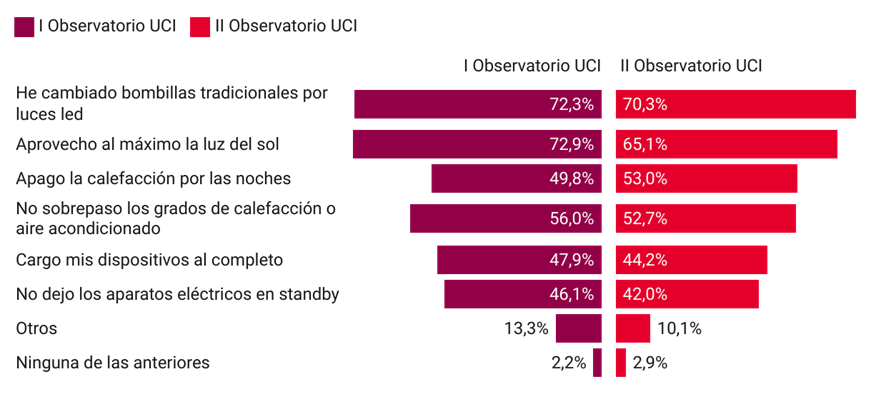
Good practices at home.
In an economic context where housing costs and household expenses represent a significant burden for families, it is encouraging to see that 75.5% of Spaniards report saving part of their income each month. However, we cannot ignore that almost a quarter of the population still lacks the capacity to save, which underscores the need to emphasize the importance of financial education and promote awareness of home renovation as a way to reduce energy consumption in homes,” explains Càtia Alves, Director of Sustainability at UCI.
*The calculation was based on data from the Wage Structure Survey published by the National Institute of Statistics (INE) (2022 data - last data published in June 2024), where the average annual salary was 26,948.87 euros per worker and 1,924.92€, distributed in 14 payments.


