Madrid, March 4, 2024 – This Tuesday, March 5, marks World Energy Efficiency Day, an event that aims to raise awareness about the rational use of energy and encourage reflection on the excessive use of fossil fuels and the importance of developing renewable energy sources. With our building stock representing a third of the country's energy consumption, the need to address energy efficiency in homes is becoming increasingly urgent.
In this regard, UCI, a specialist in sustainable finance, has conducted a study to analyze the state of the residential housing stock and the distribution of Energy Performance Certificates in Spain. This analysis reveals that almost nine out of ten homes (86.9%) have an energy rating of E, F, or G, the worst in terms of consumption and emissions, and that the most common rating in Spanish homes is E (55.9%).
By autonomous community, Navarre (2.29%), Castile and León (1.71%), and Galicia (1.36%) are the three communities with the most residences with A Certification, thus exceeding the Spanish average of 0.70%. At the other end of the spectrum are the Canary Islands (66.93%), the Basque Country (31.79%), and Asturias (26.98%), which have the highest percentages of homes with G Certification, surpassing the Spanish average of 20.22%.
“Living in an inefficient home, type F or G, means double the consumption of an E-rated home, which is the most common in our country, and up to 100% compared to an efficient home rated with the letter A,” says Catia Alvés, Director of Sustainability and Rehabilitation at UCI.
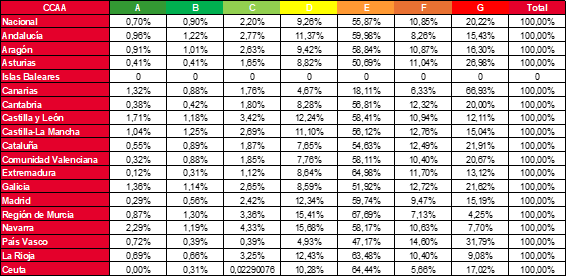
Table: The results obtained for Residential building types built up to December 31, 2020 are shown, grouped by Autonomous Community*
While these figures are due to the age of the housing stock in Spain – whose average age exceeds 43 years – since they were built before the entry into force of the Technical Building Code, this scenario contributes to excessive energy consumption, not only moving homes away from ideal comfort levels, but also causing unnecessary expenses on energy bills, and added to this is the fact that the VAT on electricity will increase from 10% to 21% this March for almost all households and gas will do so next April.
According to Catia Alvés: “The solution to this challenge lies in a comprehensive perspective that involves raising awareness among citizens and increasing the current rate of renovations tenfold thanks to greater agility from the administrations in granting aid to homeowners' associations.”
These figures highlight the urgent need for the Energy Performance of Buildings Directive (EPBD) to be approved, as it is crucial for improving energy efficiency in the residential sector. Its adoption will facilitate the transition to more sustainable and energy-efficient homes, thus contributing to reduced energy consumption and improved comfort in the home. This step represents a significant advance towards achieving sustainability and energy efficiency goals at both the national and European levels.
Not all autonomous communities publish the same data, nor with the same level of completeness. Some communities provide emissions and consumption ratings, along with the corresponding figures for each, while others do not. The Balearic Islands deserve special mention, as they do not provide one of the ratings, although they do provide the corresponding figure in some volume. Furthermore, Melilla has not yet published or provided access to its data, so only occasional information is available.


