Madrid, March 13, 2023
The European Commission's approval of the Energy Performance of Buildings Directive (EPDB) sets 2030 as the deadline for homeowners and buyers of homes with energy ratings of G or F (i.e., the lowest) to renovate and refurbish them to achieve at least an E rating. These criteria will increase to D in 2033 and will require the renovation of a large proportion of homes in all EU member states, including Spain.
Are Spaniards prepared to take on this challenge? Are homeowners and buyers aware of the lack of energy efficiency in their homes? To answer these questions, UCI (Unión de Créditos Inmobiliario), a specialist in sustainable housing finance, has launched the First Observatory on Housing and Sustainability , a comprehensive report that offers insight into the expectations that homeowners and potential buyers have regarding the energy efficiency of their homes and reflects the desires and obstacles of Spaniards in this area. For this report, more than 2,000 Spaniards aged 25 to 65, who own homes or intend to buy in the coming months, were interviewed throughout Spain.
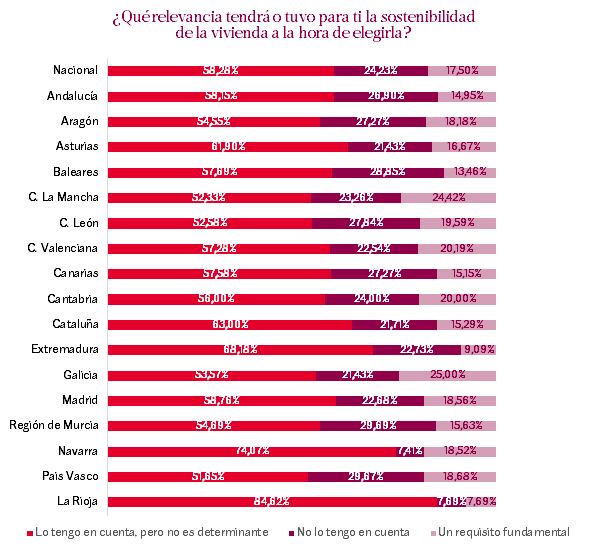
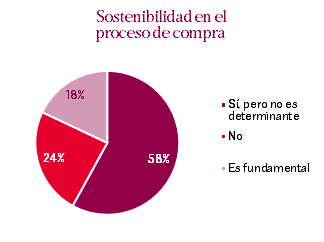 So much so that 6 out of 10 Spaniards (58.3%) take into account the sustainability and efficiency of a home when buying it , although they don't consider it a determining factor. In fact, only 17.5% of buyers and owners consider these factors a fundamental requirement .
By Autonomous Community, Galicians are the most aware of this issue, with 25% of buyers believing that the sustainability of their future home is fundamental, followed by the inhabitants of Castilla-La Mancha and the Valencian Community (24.4% and 20.2% respectively). At the other end of the spectrum are La Rioja and Extremadura , with 7.6% and 9.1% respectively.
These figures reflect the growing awareness among Spaniards regarding the sustainability of their homes and are reinforced when they are asked if they would be willing to pay a higher price to live in a more sustainable home. The response from homeowners or prospective buyers is resounding: 78.3% would pay more for a more sustainable home, up to an additional 7.25%, which would represent an extra cost of €12,682 for an average 100m² home, based on the appraised value of privately owned housing for the fourth quarter of 2022, published by the Ministry of Transport, Mobility and Urban Agenda (Mitma).
In fact, women would be willing to pay more than men, specifically an additional 7.56% on the price of housing compared to 6.94%.
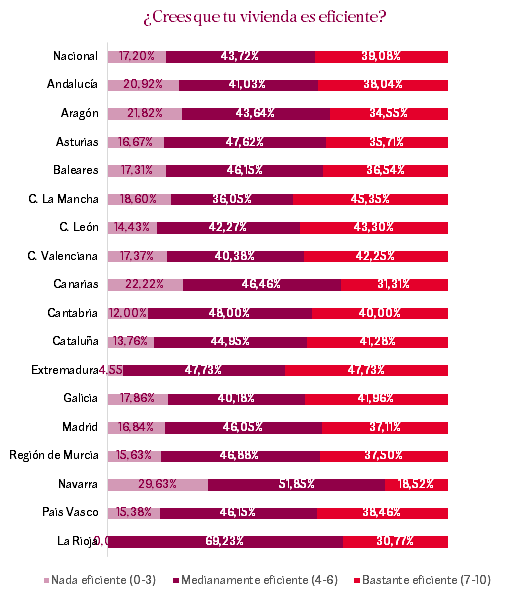
The concern exists, but do Spaniards really know what it means to have a sustainable home? The answer seems to be no. Although around 82.8% believe their home is energy efficient , data from the Institute for Energy Diversification and Saving (IDAE) reveals that more than 80% of buildings and homes in Spain have an inefficient energy rating of E, F, or G.
 Green mortgages, a solution still unknown to Spaniards
Green or sustainable financing has been gaining relevance in the last five years, in line with the essential reduction of greenhouse gas emissions and spurred on by the disbursement of Next Generation funds, which require a strict line of work towards zero emissions in a context where the Spanish building stock is quite far removed from European policy.
In fact, the supply of green mortgages has experienced significant growth in recent years. However, data from the First Observatory on Housing and Sustainability reveals that there is still widespread ignorance about these financing solutions among Spaniards , as only 14.2% claim to be familiar with green mortgages.
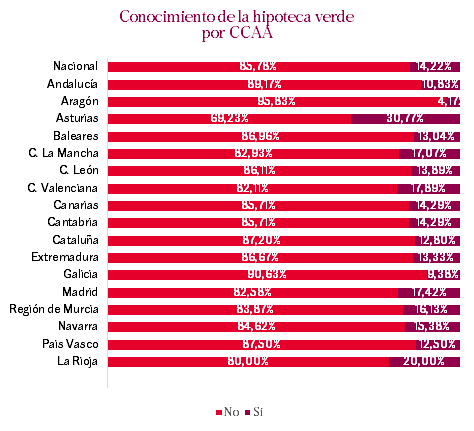 By region, buyers in Aragon are the least familiar with them (4.2%), while Asturias is the Autonomous Community with the highest percentage of buyers or owners who claim to know them (30.8%).
Despite this widespread lack of awareness, the truth is that buyers who are familiar with this type of financing often consider taking it out. This is confirmed by 31.1% of buyers surveyed by UCI , who stated they would consider taking out a green mortgage, compared to 24.3% who would opt for a conventional mortgage.
When asked about the factors that make these solutions more attractive, 62.4% of homeowners and potential buyers mentioned savings on heating and electricity as the most relevant criterion for choosing a green mortgage, ahead of the bonuses offered by these solutions (55.4%), and obtaining a higher percentage of financing (41.4%).
Spaniards want to renovate their homes
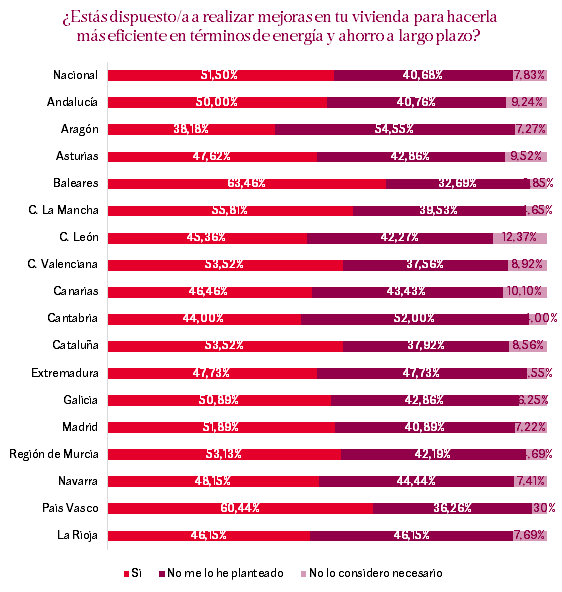
The truth is that most Spaniards believe it's necessary to do their part in their homes to build a more sustainable world, and more than half (51.5%) would be willing to do so through energy-efficient renovations or upgrades to make their homes more efficient , compared to 40.7% who haven't considered it and 7.8% who don't see it as necessary. Furthermore, two out of three homeowners nationwide already see it as a goal to achieve, as they want to renovate their homes within the next five years.
Of all those surveyed, the owners and buyers from the Balearic Islands are the most willing to make these improvements (63.5%), followed by Basques (60.4%) and people from Castilla-La Mancha (55.8%).
But what renovations are Spaniards willing to undertake to make their homes more sustainable? The majority would opt for installing solar panels to generate their own electricity (56.8%), followed by installing insulated windows (55.1%) and improving the thermal insulation of their homes (53.2%). According to the study conducted by UCI , most Spaniards, specifically 70.7%, would invest up to €10,000 in these improvements.
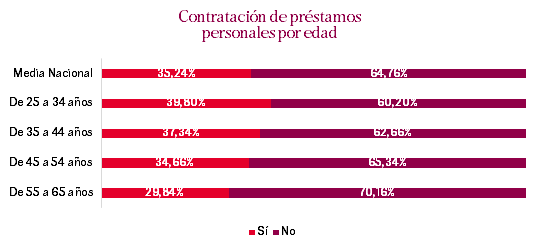
However, not all Spaniards would be willing to take out a personal loan to cover the cost of the renovation, as only four out of ten (35.2%) would choose this financial solution. It is worth noting that young people aged 25 to 35 are the most willing to do so.
Fortunately, those interested in undertaking these types of renovations don't have to rely solely on their available savings or financing. The EU's Next Generation funds include a specific allocation for financing the renovation of residential buildings, while energy efficiency improvements can benefit from income tax deductions of up to 60% of the amounts paid.
However, the lack of awareness of these facilities is one of the major obstacles to achieving energy efficiency goals, since the vast majority of homeowners (90.7%) are unaware of these tax breaks , while 86.7% are unaware of the existence of regional and state subsidies for home renovation.
A country of neighbors
Spain has the second-highest percentage of apartments in Europe, surpassed only by Latvia (66%), and well above the eurozone average of 47.9%. Of the 26 million homes in Spain, nearly half were built before 1980, resulting in accessibility issues, poor thermal insulation, and, in many cases, a state of disrepair.
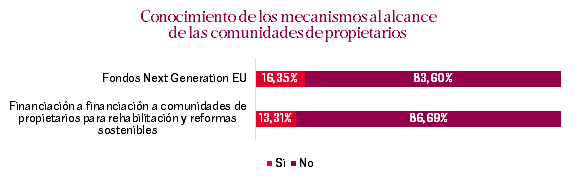
In this respect, the arrival of Next Generation EU funds is a great opportunity for the decarbonization of a sector that consumes 30% of energy and generates nearly 40% of greenhouse gas (GHG) emissions. Thus, this report reveals that 83.6% are unaware of the existence of Next Generation EU funds.
Less, although equally high, is the lack of awareness of the existence of financing for communities after the modification in the regime of communities established in the Horizontal Property Law, since 77.7% claim to be unaware of the existence of specific financing for the rehabilitation of the properties in which they reside.
When asked about the reforms that the buildings they live in need most, Spaniards point to the installation of solar panels (57.8%), the placement of External Thermal Insulation Systems (ETICS), the improvement of accessibility (36.1%) or the change of heating systems (34.5%).
However, the cost of these actions (68.5%), getting the neighbors to agree (57.9%) or the time it will take to amortize the investment (30.4%) are other major obstacles that prevent energy rehabilitations in communities of neighbors.
“There is an urgent need to raise awareness among the Spanish population. This is the major task that remains if we want to achieve European targets and reach climate neutrality by 2050,” warns Cátia Alves, Director of Sustainability & Renovation at UCI , who also points out that “it is necessary to make homeowners and buyers aware that undertaking energy-efficient renovations in their homes is not only good for the planet, but also for their wallets in a context of high inflation and energy prices like the one we are currently experiencing.”
As one of the entities adhering to the Spanish Global Compact Network , UCI contributes with the 1st Observatory on Housing and Sustainability to SDG 13 Climate Action (associated with its target 3): improve education, awareness and human and institutional capacity regarding climate change mitigation, adaptation to it, reduction of its effects and early warning.


