Madrid, November 20, 2025 – The arrival of Black Friday and Cyber Monday marks the start of the biggest shopping season of the year. According to a report by KPMG and Appinio Spain, consumers will spend an average of €379, 12% more than in 2024. Although discounts have been extended to practically all consumer categories, electronics continue to lead purchases during this period, representing 50% of sales*.
In this regard, a study by UCI (Unión de Créditos Inmobiliarios), an entity specializing in sustainable financing, reveals that 78% of Spaniards would be willing to invest in technology to turn their house into a smart home. 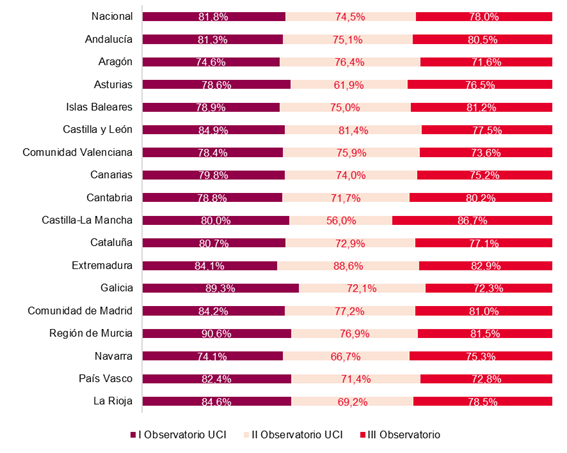
Spaniards willing to invest in home automation
By region, people from Castilla-La Mancha (87%), Extremadura (83%) and Andalusia (80.5%) are the most willing to invest in home automation, while people from Aragon (72%), Galicia (72.3%) and the Basque Country (73%) show less interest in this type of home technology.
Interest in investing in smart home solutions varies by age. 84.7% of people aged 25 to 34 say they are willing to invest in home automation, followed by 82.4% of those aged 35 to 44 and 78.5% of the 45 to 54 age group. Purchase intent drops to 69.7% for those 55 and older.
By income level, the willingness to participate increases as purchasing power increases. Households with less than €21,000 show a 73.9% interest rate, a figure that rises to 77.2% among those earning between €21,000 and €30,000. The percentage reaches its highest point (81.9%) in households with incomes exceeding €30,000.
How digitized are Spanish households?
Regarding the degree of home digitization, Spaniards have an average of 1.9 smart devices, a figure higher than the 1.78 devices registered in 2024.
Although there are hardly any regional differences, Murcia (2.5) and Andalusia (2.4) are the most digitized communities, while Castile and León and the Basque Country are at the bottom with an average of 1.4 devices per household. 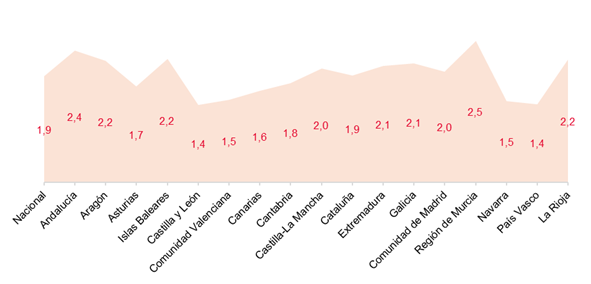
Degree of digitization of households
Home digitalization is also explained by age and income. Young people aged 25 to 34 are the ones who incorporate the most connected devices (2.6 on average), well above the 35 to 44 age group (2), 45 to 54 age group (1.9) and 55 to 65 age group (1.5).
By income level, households with less than €21,000 have 1.4 devices, those with income between €21,000 and €30,000 reach 1.6, and those with incomes exceeding €30,000 also reach 2.6, placing them as the most digitized.
Comfort and efficiency: the most valued advantages of the smart home
The integration of home automation solutions is primarily perceived by Spaniards as a way to gain convenience and comfort (67%). Energy savings (61%) and improved security (52%) are also valued. To a lesser extent, respondents highlight values such as sustainability (32%) and innovation (25%) as other benefits of turning their home into a Smart Home. 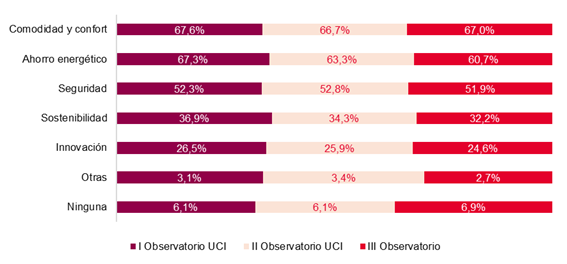
Advantages of integrating home automation for Spaniards
Furthermore, 77% of Spaniards believe that living in a smart home would improve their quality of life, while 19% would need more information about its advantages or do not perceive a direct impact (4%).
Thermostats and smart light bulbs are the most in-demand IoT devices
The devices that generate the most interest among Spaniards are smart thermostats (40%), followed by smart bulbs (38%) and smart plugs and switches (37%).
Meanwhile, the solutions with the greatest presence in homes are the robot vacuum cleaner (18.4%) and smart assistants and speakers (18.1%). 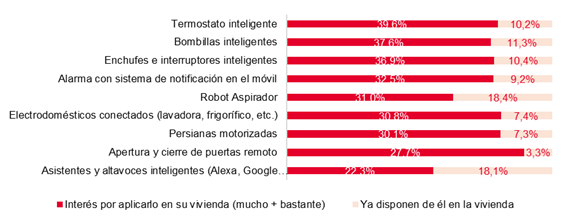
Types of devices with the greatest interest and presence in homes
*Data from the Idealo price comparison website.


